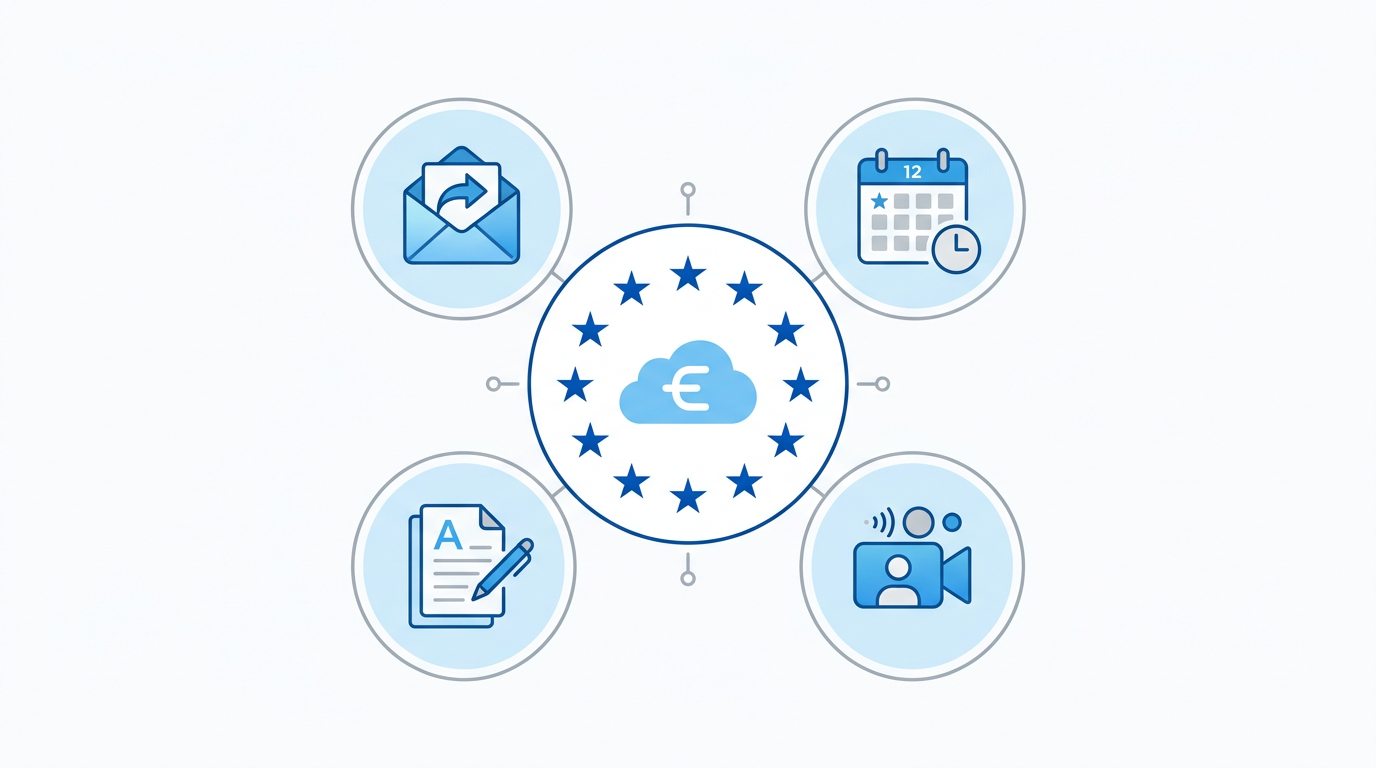
A Dutch company called EUfforic Europe BV quietly launched a product called Office EU on March 4, 2026. The pitch is simple: a full cloud productivity suite, hosted entirely in Europe, built on open-source software, outside the reach of US law. No Microsoft, no Google, no CLOUD Act.
I’ve been following this space for a while. Europe has been building toward something like this for years, and Office EU is the clearest attempt yet to package it into something ordinary organisations can actually use.
What it is under the hood
Office EU is not its own software. It’s a branded deployment of Nextcloud Hub with Collabora Online as the document editor. Both are open source. Nextcloud is a mature file sync and collaboration platform that’s been around since 2016. Collabora Online is a hosted version of LibreOffice, repackaged for the browser with real-time collaboration.
The infrastructure runs on Hetzner data centres in Helsinki. EUfforic chose Hetzner specifically because it is German-owned and keeps data inside the EU, away from the US CLOUD Act (which lets US authorities compel American companies to hand over data regardless of where it’s stored).
The full feature set covers the obvious bases. EU Docs, Spreadsheet, and Presentation run through Collabora Online and support .docx, .xlsx, and .pptx with simultaneous editing. EU Drive handles file storage with versioning, link sharing, password protection, and expiry dates. EU Mail is encrypted IMAP/SMTP email with no ads. EU Calendar is CalDAV-based with shared calendars and event invites. EU Talk does video calls, chat, and screen sharing with end-to-end encryption.
That covers the core of what most small teams actually use in Microsoft 365: documents, storage, email, calendar, and video calls.
What it is not
It is not a feature-for-feature replacement for Microsoft 365 enterprise. The product doesn’t include anything like Power BI, Teams Live Events, Copilot, advanced compliance tooling, or deep Azure Active Directory integration. If your organisation relies on those, Office EU is not your answer right now.
Collabora Online also has a reputation for edge-case formatting issues with complex Excel files or heavily formatted Word documents. The more intricate the original, the more likely something will look slightly off. Most day-to-day documents are fine. Anything with elaborate macros or pivot tables, less so.
How it compares to Microsoft 365
The honest comparison comes down to what you’re optimising for.
Microsoft 365 wins on feature depth. The ecosystem is huge, the desktop apps are the standard, and the integrations are everywhere. If your team is already in the Microsoft world, switching costs are real and the alternatives genuinely lack things you use.
Office EU wins on data residency. Your files sit on servers in Helsinki, operated by a Dutch company, governed by EU law. There is no US entity in the chain. For European public sector organisations, NGOs, or anyone handling data where GDPR compliance matters more than convenience, that’s a meaningful difference.
It also wins on auditability. Both Nextcloud and Collabora Online are open source. Anyone can read the code. That’s not the case with Microsoft 365.
Pricing is positioned as comparable to Microsoft 365 Business Standard, which is around €5.50 per user per month at the entry level. Office EU doesn’t publish exact numbers publicly yet, though the company says plans are tiered for individuals, SMEs, and enterprise, with volume discounts available on request.
The sovereignty angle
This isn’t just a product launch. It’s happening against a specific political backdrop.
All 27 EU member states signed a declaration in November 2025 stating their shared ambition to reduce strategic dependencies on non-European cloud providers. The European Commission has been pushing public sector organisations to evaluate alternatives. And Gartner forecasts that spending on sovereign cloud infrastructure in Europe will more than triple to $23 billion by 2027.
Office EU arrived at a moment when the demand signal is unusually clear. Whether the product is good enough to capture it is a different question. But the timing is not a coincidence.
Early access attracted around 15,000 applicants. A phased rollout across Europe is planned for Q2 2026. It’s currently moving from invite-only beta to open enrollment.
Worth trying?
Depends on who you are.
If you’re an individual or a small team that uses Google Workspace or Microsoft 365 mostly for documents, email, and the occasional video call, Office EU covers that. The migration tools handle import from both platforms. The apps run in any browser and on iOS, Android, Windows, macOS, and Linux via the Nextcloud desktop client. Day-to-day usage would feel familiar enough.
If you’re a European public sector body or an organisation handling sensitive data, this is probably worth evaluating properly. The data sovereignty story is clean, the stack is auditable, and Nextcloud has a long enough track record that you’re not betting on something unproven.
If you’re a larger enterprise with deep Microsoft integration, Power Platform usage, or Teams Live Events, it’s too early. Wait for the product to mature and for independent assessments of how it handles scale.
I’ll probably spin up a personal account when open enrollment starts and write a follow-up once I’ve used it for real. The concept is solid. Whether the execution holds up in daily use is what actually matters.
Related posts: What is MCP and how to set it up in Claude Code, Building a local RAG system as persistent memory for Claude Code